
Research Roundup: Jan 20, 2026
- Jan 19
- 3 min read
Best of cannabinoid science this week...
In a survey of older adults, the most common reasons for cannabis use were relaxation, sleep, enhancement, pain & mental health/mood
Older Adults’ Perspectives on and Experiences with Cannabis Use: Results From the 2024 National Poll on Healthy Aging
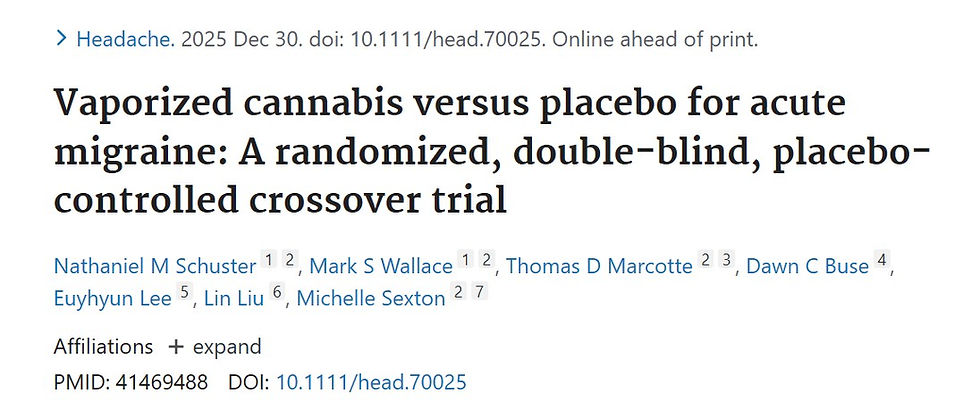
For migraines, vaporized THC/CBD caused pain relief, pain freedom & most bothersome symptom freedom, but no help from vaped CBD
Vaporized cannabis versus placebo for acute migraine: A randomized, double-blind, placebo-controlled crossover trial
For Aromatase Inhibitor-Associated Musculoskeletal Syndrome (AIMSS, bone loss & joint pain from the cancer treatment of aromatase inhibitors), topical cannabis balm improved symptoms
A Randomized, Open-Label Trial to Assess Feasibility and Tolerability of Topical Cannabis Balms for the Treatment of Aromatase Inhibitor-Associated Musculoskeletal Syndrome (AIMSS)
In people with psoriasis, 8 weeks of CBD reduced their inch scores & time to sleep onset but did not improve their Psoriasis Area & Severity Index (PASI) scores
Efficacy and safety of cannabidiol oil in psoriasis: a randomized, double-blind, placebo-controlled
In giving a liposomal synthetic CBD injection to dogs, they had significant improvements to pain, lameness scores & behavior
Efficacy, pharmacokinetics and safety of liposomal synthetic cannabidiol injected subcutaneously in dogs: A randomized, blinded, placebo-controlled, crossover clinical trial
https://www.frontiersin.org/journals/veterinary-science/articles/10.3389/fvets.2025.1746266/abstract
For CBD & heart disease, a review of its potential for ischemia-reperfusion injury (tissue injury after return of blood supply), myocardial fibrosis (scarring & collagen in the heart muscle), cardiac arrhythmias (abnormal heart rhythms) as well as pericarditis & myocarditis (inflammation of heart regions)
Cannabidiol in Cardiovascular Disease: A Review of Current Evidence and Future Directions
In people with head & neck cancer, a review of medical cannabis for symptoms such as chronic pain, nausea, vomiting & anxiety
Medical Cannabis for Best Supportive Care of Patients Affected by Cancers of the Head and Neck: A Narrative Review
On CBD’s potential for neuronal repair
Cannabidiol extending beyond neuroprotection toward neuronal repair: A potential regenerative modulator
In stem cells, CBD preserved their stemness & delayed aging, potentially via Sirtuin 1 & the regulation of autophagy (cellular recycling)
Cannabidiol Enhances SIRT1 and Autophagy for the Maintenance of Human Mesenchymal Stem Cells
In a mouse model of Alzheimer’s disease, a few months of ultra-low dose THC injections lowered cognitive decline, with males having less inflammation in the hippocampus (memory center of the brain) & females having less inflammation in the prefrontal cortex
Sex-dependent effects of ultra-low-dose-THC preventive treatment on neuroinflammation and cognitive decline in 5xFAD mice
In a rat model of Alzheimer’s disease, THC lowered cognitive impairments via increased neuronal survival, prevention of morphological aberrations (shape changes) & reduced neuronal apoptosis (programmed cellular suicide)
Delta-9-Tetrahydrocannabinol (Δ9THC) Treatment Improves Neuronal Survivability by Ameliorating Neuronal Apoptosis and Increasing Calbindin Expression in the Pyramidal Cells of Alzheimer-Induced Rat Hippocampus
In a mouse model traumatic brain injury, CBD caused neuroprotective effects by lowering oxidative stress & apoptosis (programmed cellular suicide)
Cannabidiol improves cognitive impairment after traumatic brain injury by attenuating neuronal oxidative stress and apoptosis via the SET/PP2A/Akt signaling axis
In a mouse model of depression, CBD reduced depressive-like behaviors, improved synaptic health in the hippocampus (memory center of the brain), increased antioxidant effects & helped the mitochondria (powerhouse of the cell)
Cannabidiol Alleviates LPS-Induced Depressive-Like Behaviors Via Improving Mitochondria Function
In a model of skin tissue damage from particulate matter, a CBD nanoemulsion reduced inflammation & protected from extracellular matrix degradation
Application of Cannabidiol Nanoemulsion for Skin Protection Against Particulate Matter: Evidence from an Ex Vivo Human Model
On the anti-inflammatory & antioxidant effects of 10 major non-psychotropic cannabinoids with CBDV being the strongest anti-inflammatory, the best combo being CBG & CBN & the acids being particularly good at absorbing free radicals
Phytocannabinoids as anti-inflammatory agents: Synergistic effects when combined with Cannabis sativa L. matrices


Comments