
Research Roundup: May 12, 2026
Best of cannabinoid science this week...
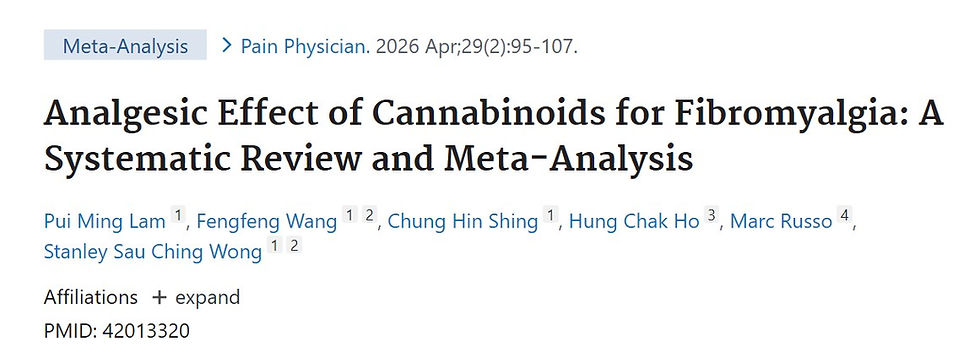
For fibromyalgia, a meta-analysis of 12 clinical studies found cannabinoids reduced pain intensity & were linked to significant improvements in sleep quality, anxiety, depression & quality of life
Analgesic Effect of Cannabinoids for Fibromyalgia: A Systematic Review and Meta-Analysis
In people with chronic pain, medical cannabis caused a 65% reduction in the use of opioids with an increase in physical functioning scores
Medical Cannabis as an Opiate Alternative: A Prospective Observational Cohort Study
In 2 people with chronic neuropathic pain, case studies of 1:1 THC:CBD reducing pain intensity, lowering painkilling medications & improving multiple areas of health-related quality of life, especially social functioning & perceived health
Integrating Oral THC:CBD Into Chronic Neuropathic Pain Management in Primary Care: A Two-Patient Observational Case Series
In children with rare epilepsy disorders, CBD improved seizures (sometimes greatly) as well as sleep, behavior & attention
Real-world effectiveness of highly purified cannabidiol in epilepsy associated with 15q11.2-q13.1 duplication and deletion syndromes: A multicenter study
And in children with developmental & epileptic encephalopathies (severe, early-onset brain disorders), CBD isolate reduced seizures & was well-tolerated
Real-world effectiveness and tolerability of highly purified cannabidiol in patients with monogenic developmental and epileptic encephalopathies with highly active epilepsy
For metabolic diseases, cannabis use was associated with modestly lower risks of metabolic diseases, hypertension, type 2 diabetes & obesity, especially among people with a lower body-mass index (#metabolism)
Association between Cannabis use and risk of Metabolic disease in UK Biobank
For the benefits of cannabis on sleep, this review of 20 studies found that it was more effective in people with anxiety or depression
Joint Relations Among Cannabis, Sleep, and Affective Symptomatology: A Scoping Review
For aging, a review on the importance of dosing THC & CBD
Navigating Dose-Effect Complexities and Challenges in Cannabinoid Therapy for Aging-Related Neurobiological Changes
In neurology, a review on the use of CBD
Cannabidiol in Neurology: Current Insights and Translational Perspectives
For central nervous system disorders, a review of cannabinoids with a focus on redox tone, glial state programs, circuit stability & autophagy (cellular recycling) or unfolded protein response signaling
Phytocannabinoids in Central Nervous System Disorders and Frameworks for Cellular Stress Adaptation: A Comprehensive Review
On oleoylethanolamide (the endocannabinoid of satiation) for alcohol use disorder, a review of its mechanisms of action
Molecular targets of oleoylethanolamide in the pathogenesis of alcohol use disorder: Mechanisms of central and peripheral action
For endometriosis, a review of the preclinical evidence found cannabinoids reduced pain via lowering the release of inflammatory mediators, inhibiting signals of the nociceptors (pain receptors), modulation of neuroinflammation & on the lesions themselves, anti-proliferation & apoptosis (programmed cellular suicide)
Insights Into the Role of Cannabinoids in the Management of Endometriosis-Associated Pain
For wound healing, a review of hydrogels loaded with CBD
Cannabidiol-Loaded Smart Hydrogels for Advanced Wound Healing: Drug Delivery Innovations and Therapeutic Perspectives
For the gut-liver axis, a review of the potential benefits of CBD
Cannabidiol as a Modulator of the Gut-Liver Axis: Clinical and Pharmacological Insights into Hepatic and Metabolic Disorder Therapies
In chickens exposed to avian infectious bronchitis virus (a coronavirus), CBD suppressed viral replication & markedly alleviated clinical symptoms
Inhibitory effect of cannabidiol on infectious bronchitis virus in chickens in vitro and in vivo
In a rat model of menopause, CBD completely prevented hot flashes but did not alter uterine atrophy
Cannabidiol Prevents Ovariectomy-Induced Thermoregulatory Dysfunction in Rats: A Preclinical Study on Menopausal Vasomotor Symptoms
In a rat model of traumatic brain injury, an analysis found both CBD & THC were required for restored learning & memory as well as neuroprotection, with the superior dose ratio being CBD:THC at 300:1 to 10:1
The cannabidiol (CBD): Tetrahydrocanabinol (THC) concentration ratio is critical for neuroprotection and recovery following traumatic brain injury


Comments